The AI Back Office: Why Project Sites Are About to Get a Lot Leaner
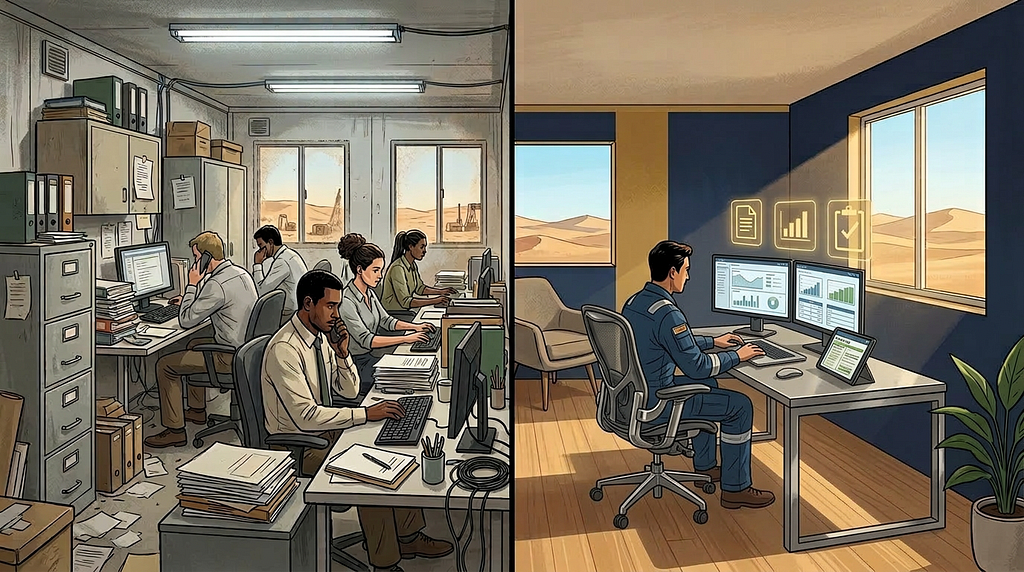
How AI agents will replace support functions on remote project sites, and what that means for the people who run them.
I’ve spent 20 years managing operations on remote project sites across North and West Africa. Mining camps, oil and gas bases, construction compounds. Places where every person on site costs money: a bed, a desk, three meals a day, transport, and an office to sit in.
Over the years, the back office grew. Document controllers, planners, resource schedulers, compliance officers, daily report writers. Each role justified. Each role adding overhead.
I believe most of these roles are about to disappear.
The shift is already underway
AI isn’t just getting better at generating text or answering questions. It’s becoming genuinely capable of operational work: tracking documents, flagging non-compliance, optimizing resource schedules, drafting reports from structured data, and maintaining audit trails.
What used to require a team of five or six back-office staff can now be handled by a single operational manager who knows how to deploy and orchestrate AI agents. Not someone who “uses ChatGPT.” Someone who builds workflows, integrates systems, and treats AI as a team rather than a tool.
This is the difference between knowing how to use a spreadsheet and knowing how to run a business on one.
What this means for remote sites
On a typical remote project site, you’ll find support functions like:
- Accounting clerks
- Administrative secretaries
- Supply chain coordinators
- HR officers
- Document controllers
- HSE compliance assistants
Each one occupies space. Each one needs accommodation, meals, amenities, and management attention. On a camp-based operation, that translates directly to bed space, catering costs, and facility maintenance.
Replace those roles with AI agents managed by a competent operations lead, and the site profile changes dramatically. You go from 80 people to 50. From three office containers to one. From a kitchen serving 200 meals a day to 120.
The savings are not marginal. They’re structural.
The culture effect nobody talks about
There’s a secondary effect that’s harder to quantify but equally important.
Support staff on remote sites are often the ones who push for better amenities, upgraded accommodation, and office comfort improvements. This is entirely understandable. Their work doesn’t require them to be on site; they’re there because the organization decided to staff those functions locally. Naturally, they want conditions that reflect a normal office environment.
Remove those positions, and the site becomes more cohesive. Everyone remaining is there for the same reason: the field work. Standards become uniform. Expectations align. The gap between “office staff” and “field staff” closes because there’s only one group left.
This isn’t about making life harder for anyone. It’s about recognizing that the model of staffing full support teams on remote sites was always a compromise. AI is removing the need for that compromise.
Direct line to headquarters
The most significant operational change is what happens to the reporting chain.
Today, site data passes through multiple hands before it reaches headquarters. A technician records a measurement. A clerk enters it into a system. A coordinator compiles a report. A manager reviews it. By the time it reaches the decision-maker, it’s been filtered, delayed, and sometimes distorted.
With AI agents handling data capture, compilation, and reporting, field teams can report directly to headquarters in near real-time. No intermediaries. No information loss. Faster decisions, better accountability.
This flattens the organization in a way that org chart redesigns never could.
Who benefits
The operational managers who embrace this shift will become extraordinarily valuable. They won’t just manage people. They’ll manage a hybrid team of humans and AI agents, orchestrating workflows that previously required an entire department.
The field technicians, engineers, and supervisors who do the actual work will benefit from lighter sites, faster support, and less bureaucracy.
The organizations that move first will win contracts on cost competitiveness alone, before you even factor in speed and quality improvements.
Who needs to pay attention
If you’re running back-office operations on remote project sites, this is your moment. Not to panic, but to prepare. The transition won’t happen overnight, but the direction is clear.
The project site of 2030 will look nothing like the project site of 2020. The question is whether you’ll be the one building it.